Home » News » Company News » Why We Recommended Hot Dip Galvanized One-Piece Flange & Grade 8.8 Tie Rods for a DN1600 EPDM Rubber Joint – A Real Project Case (Egypt)
Why We Recommended Hot Dip Galvanized One-Piece Flange & Grade 8.8 Tie Rods for a DN1600 EPDM Rubber Joint – A Real Project Case (Egypt)
2026.05.27
1. Introduction: A Challenge from Egypt
“Can we use standard painted flanges and ordinary carbon steel tie rods for a DN1600 rubber expansion joint?”
This was the initial request from a project procurement manager in Egypt. The application was a large-diameter water transmission line with significant thermal movement, vibration, and occasional pressure surges.
Our reply was clear: Yes, but here is why you should not.
After multiple technical discussions, site condition analysis, and lifecycle cost comparison, the customer agreed to upgrade to our recommended design:
Hot dip galvanized one‑piece flange
Grade 8.8 high-strength tie rods
Below, we explain the engineering logic behind each choice, how we convinced the customer, and why this decision saves long-term operational risk.
2. Why Hot Dip Galvanized One‑Piece Flange?
The Problem with Standard Flanges
Most rubber expansion joints come with painted carbon steel flanges or split‑type flanges. For a DN1600 (64-inch) joint, two risks emerge.
First, painted flanges are highly vulnerable to corrosion. In humid or coastal environments, rust can develop within one to two years, breaking the seal and causing leakage. Second, split‑type flanges tend to deform under uneven bolt compression. At large diameters like DN1600, even slight flange deflection leads to poor gasket sealing and eventual failure.
Our Recommended Solution: Hot Dip Galvanized One‑Piece Flange
We recommended a hot dip galvanized one‑piece flange for three key reasons.
Reason one – long-term corrosion protection. Hot dip galvanizing provides a zinc coating thickness of 85 to 100 microns. This delivers 20+ years of protection, making it ideal for Egypt’s coastal projects and high-temperature zones.
Reason two – no weld seam, no split. The one‑piece forged or rolled flange maintains perfect roundness even under high bolt torque. Unlike split flanges, it will not deform during installation.
Reason three – full-surface coverage. The zinc coating protects the flange edge, bolt holes, and mating face. This prevents “red rust” creep, a common problem with painted flanges where rust migrates under the coating.
Common Questions from Engineers
What is the best flange coating for large rubber expansion joints in hot climates?
Hot dip galvanizing. It withstands 80°C continuous temperature, UV exposure, and occasional salt spray – all relevant to Egypt’s environment.
One‑piece vs split flange for DN1600 rubber joint – which is better?
One‑piece is the clear winner. It prevents flange deflection during bolting, ensuring uniform gasket compression. Split flanges often leak at large diameters due to uneven bolt load distribution.
3. Why Grade 8.8 Tie Rods?
The Role of Tie Rods in Large Rubber Joints
Tie rods limit axial extension beyond the joint’s rated movement. Without proper tie rods, pressure thrust or pipe movement can over‑stretch the rubber, causing blowout or end ring failure. For a large diameter joint like DN1600, tie rod strength is not optional – it is critical.
The Common Mistake
Many suppliers provide Grade 4.6 or 5.6 threaded rods. These are acceptable for small diameters. But for a DN1600 joint operating at 10 bar pressure, the axial thrust force exceeds 12,000 kg. Grade 4.6 rods would yield – meaning they permanently deform – under this load. Once a tie rod yields, it can no longer limit joint extension, and the rubber body becomes vulnerable to over‑stretching.
Why Grade 8.8?
Grade 8.8 high-strength steel offers a tensile strength of 800 MPa, compared to only 400 MPa for Grade 4.6. Its yield strength is 640 MPa versus 240 MPa for Grade 4.6. This means Grade 8.8 rods can handle more than double the load before any permanent deformation occurs.
For the DN1600 Egypt project, Grade 4.6 rods would fail under the calculated thrust force. Grade 8.8 rods provide a safe engineering margin. Additionally, when hot dip galvanized, Grade 8.8 rods maintain excellent corrosion resistance – unlike lower grades where the galvanizing process can reduce strength.
Additional Safety Feature
We supplied double nuts plus lock washers on each tie rod. This prevents loosening from cyclic vibration, which is a common failure point in large-diameter joints handling variable flow or pump operation.
Common Questions from Engineers
How many tie rods for a DN1600 rubber expansion joint?
We recommend 8 to 12 rods depending on pressure rating. For this Egypt project, we used 10 rods of M30 size with Grade 8.8 material, all hot dip galvanized after threading.
What happens if you use Grade 4.6 tie rods on a large rubber joint?
The rods will stretch permanently under pressure thrust. Once stretched, they no longer control axial movement, and the rubber joint can elongate beyond its design limit – leading to blowout or flange pull-out.
4. The Customer Communication Journey
Initial Inquiry
The customer’s initial email was straightforward: “Please quote DN1600 EPDM rubber joint with standard painted flanges and normal tie rods. Budget is tight.”
Our Response – Not Just a Quotation, But a Consultation
We did not simply say “no” to their request. Instead, we provided value through technical consultation.
First, we sent a one‑page risk comparison showing painted versus hot dip galvanized flanges, and Grade 4.6 versus Grade 8.8 tie rods. The comparison highlighted failure modes, expected service life, and replacement costs.
Second, we included a simple thrust force calculation for DN1600 at 10 bar pressure. Seeing the actual number – over 200,000 kgf of axial thrust – made the customer realize that ordinary tie rods were insufficient.
Third, we shared photographs of failed painted flanges from another Middle East project with a similar climate. The rust and leakage visible in those photos were a powerful visual argument.
Finally, we provided a lifecycle cost analysis. The upfront cost of hot dip galvanized flanges and Grade 8.8 rods was only 15% higher than the standard option. However, the expected service life was three times longer. Over a ten‑year period, the standard option would require at least two replacements, while our recommended design would still be in service.
The Customer’s Turning Point
After reviewing our materials, the customer’s project manager replied: “We did not realize the thrust force is that high. And the rust photos from your other project – that would shut us down in 18 months.”
Three Zoom meetings followed, involving their site engineer and maintenance manager. Each meeting focused on a different aspect: corrosion protection, mechanical strength, and installation procedures.
Final Order Confirmation
The customer’s final confirmation email stated: “Proceed with your recommended design: hot dip galvanized one‑piece flanges, Grade 8.8 tie rods, double nuts. All rods also hot dip galvanized.”
The order was placed for 10 complete sets.
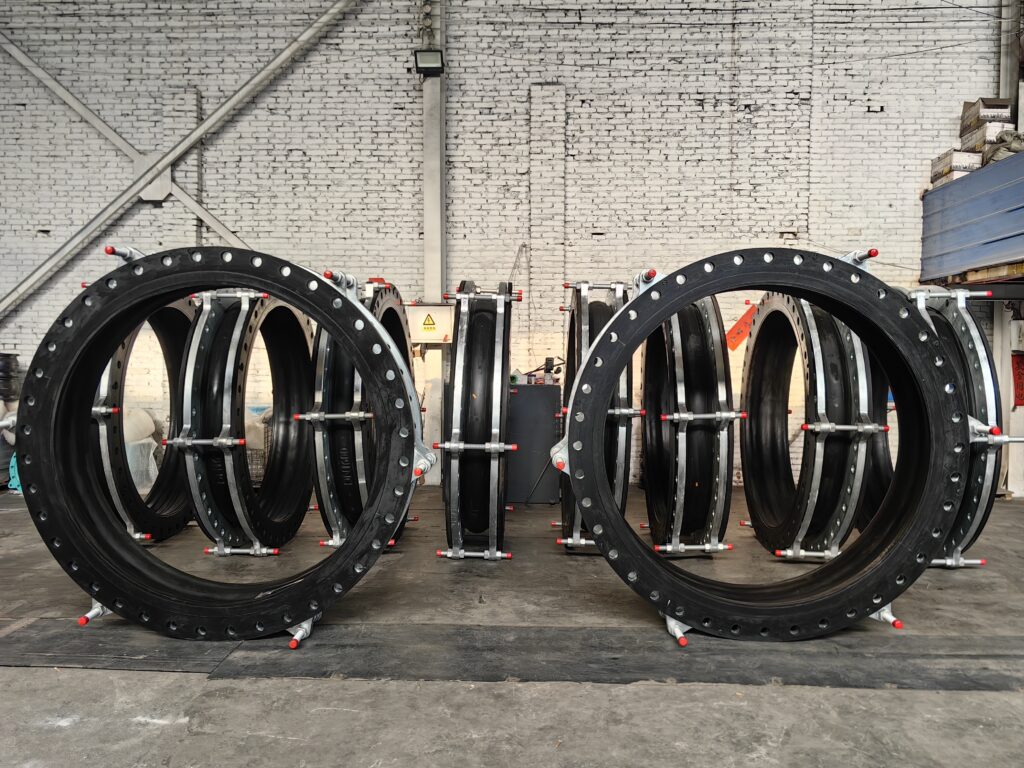
10 sets of DN1600 EPDM rubber expansion joints with hot dip galvanized one-piece flanges and Grade 8.8 tie rods – ready for shipment to Egypt.
5. What We Delivered
For this Egypt project, we delivered 10 sets of DN1600 rubber expansion joints with the following specifications.
Size: DN1600 (64 inches)
Rubber material: EPDM, suitable for temperatures from -30°C to +120°C
Flange type: One‑piece design, hot dip galvanized with a minimum coating thickness of 85 microns
Tie rod material: Grade 8.8 steel, fully hot dip galvanized after threading
Number of tie rods per joint: 10 rods, each M30 size
Nut locking system: Double nuts plus spring lock washers on every rod
Designed service life: 20+ years for the flange and tie rod assembly
6. Key Takeaways for Engineers and Buyers
When should you insist on hot dip galvanized flanges and Grade 8.8 tie rods?
Yes, upgrade to this design if any of the following apply:
The pipe diameter is DN600 (24 inches) or larger
Operating pressure is 6 bar or higher
The installation site is coastal or humid – typical for Egypt, UAE, and Saudi Arabia
Expected service life exceeds 5 years
The system experiences vibration, thermal cycling, or pump start‑stop events
The standard design may be acceptable only in these limited cases:
Small diameter (DN150 or smaller)
Dry, indoor, controlled environment with no humidity
Temporary installation lasting less than 2 years
For any other scenario, the small upfront cost premium for hot dip galvanized flanges and Grade 8.8 rods pays for itself many times over in avoided downtime and replacements.
7. Call to Action
Need a similar design review for your rubber joint project?
We do not just sell components. We help you avoid field failures before they happen.
Contact us with your pipe size, pressure rating, media type, and installation environment. We will reply with a free flange and tie rod recommendation within 24 hours.
Request your datasheet or ask for a project‑specific quotation.
8. Technical Appendix – Thrust Force Calculation
For engineers who want to verify our numbers, here is the simplified thrust force calculation used for this Egypt project.
For a DN1600 rubber expansion joint with an internal diameter of 1.6 meters, operating at 10 bar pressure (1.0 MPa):
Axial thrust = Pressure × Internal cross‑sectional area
Converting to kilograms‑force: approximately 205,000 kgf
Checking Grade 8.8 rod capacity for this application:
Each M30 Grade 8.8 rod has a tensile stress area of 561 square millimeters. Yield strength of Grade 8.8 is 640 MPa.
Yield load per rod = 640 MPa × 561 mm² = 359,000 Newtons ≈ 36,600 kgf
With 10 rods: total yield capacity = 10 × 36,600 = 366,000 kgf
Safety factor = 366,000 ÷ 205,000 = approximately 1.78
Why Grade 4.6 rods would fail:
Grade 4.6 yield strength is only 240 MPa. Yield load per M30 rod = 240 × 561 = 134,640 Newtons ≈ 13,700 kgf
With 10 rods: total yield capacity = 137,000 kgf
This is well below the 205,000 kgf thrust force. The rods would permanently deform immediately upon pressurization. Grade 8.8 is the correct engineering choice for this application.